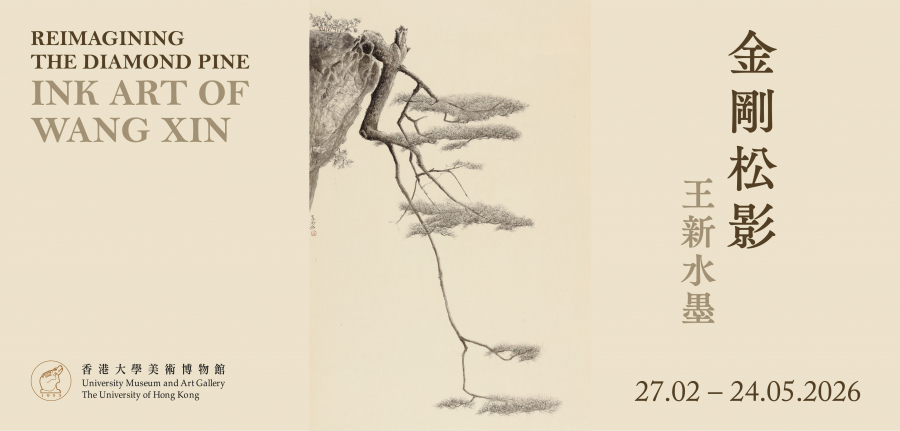
Painter and seal carver Wang Xin was born in Xingtai, Hebei province, in 1964, and graduated from the Chinese Painting Department of the Sichuan Academy of Fine Arts in 1991. He currently lives in Beijing, where he teaches Master of Fine Arts students at the Communication University of China. This unprecedented exhibition of his paintings of pine trees offers specific insights into his philosophical mindset and, more specifically, the Buddhist influence of the Diamond Sutra (Vajracchedikā Prajñāpāramitā Sūtra).
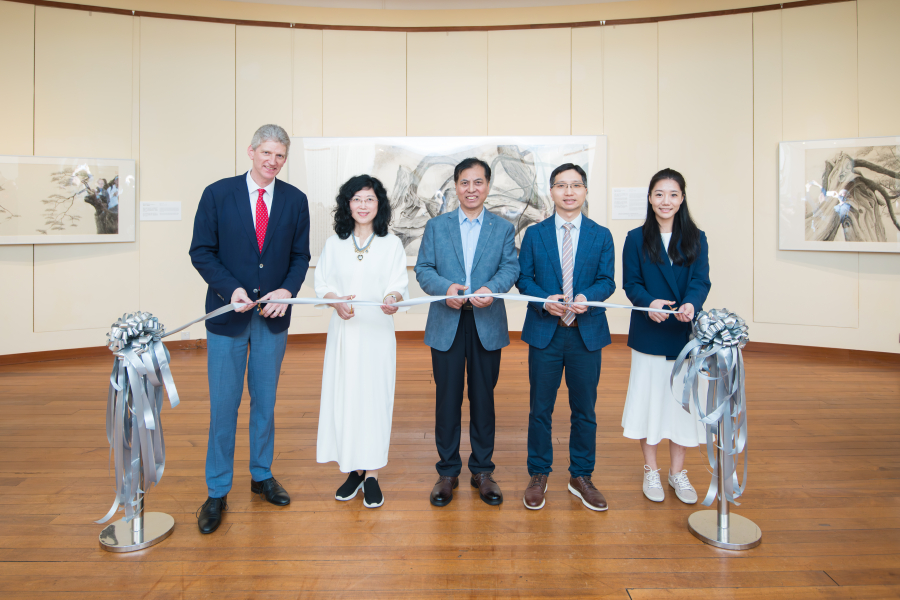
The opening of the exhibition was held at UMAG on February 26. Officiating guests included the artist Wang Xin, Dr. Qiu Zhongming, Dr. Chan Kwun Nam, Phil, UMAG Director Dr Florian Knothe and UMAG Associate Curator Dr Shuo Hua.
The artist’s large compositions combine finely rendered ink drawings of rocks and trees with excerpts from the Diamond Sutra. Reminiscent of Wang’s daily religious practice and study of the text, the sutra’s philosophy influences his compositional choices and defines how Buddhist concepts affect his use of space. A pivotal Mahayana Buddhist scripture, the Diamond Sutra is a core text in the Perfection of Wisdom (Prajñāpāramitā) tradition. Through a dialogue between the Buddha and Subhūti—one of the Buddha’s ten principal disciples, foremost in “dwelling in peace”—it teaches that reality is illusory and empty, revealing profound insights on non-self (anātman) and liberation through non-attachment, impermanence, and emptiness.
Neither meant to illustrate the scripture nor directly support its narrative, Wang’s Diamond Pine depictions carry the gravitas of the Diamond Sutra’s philosophy by depicting trees that transcend commonly expressed symbolic meanings. While in Chinese culture the pine tree symbolises longevity, endurance, steadfastness, and integrity—often representing noble scholars or gentlemen who remain strong and true despite harsh conditions—Wang’s compositions stand out for their use of void spaces. They employ a pictorial language that emphasises the longing for tranquil and peaceful isolation taught by the sutra.
For more images and exhibit captions, please click here.
Details of the Exhibition
Period: February 27, 2026 (Friday) to May 24, 2026 (Sunday)
Opening Hours:
9:30 am–6 pm (Tuesday to Saturday)
1 pm–6 pm (Sunday)
Closed on Mondays, Public and University Holidays
Venue: 1/F & 2/F, Fung Ping Shan Building, UMAG, HKU, 90 Bonham Road, Pokfulam, Hong Kong
Tel/Email: (852) 3917 5500 (General Enquiry) / museum@hku.hk
Admission: Free admission; In light of the HKU Tourist Flow Management Scheme, please enter via the ground floor of the Fung Ping Shan Building
Website: https://umag.hku.hk/exhibition/reimagining-the-diamond-pine-ink-art-of-wang-xin/
Connect with UMAG on Social Media:
Facebook: http://bit.ly/umag_facebook
Instagram: @umag_hku, #UMAG, #WangXin, #InkArt, #DiamondPine
YouTube: http://bit.ly/umag_youtube
LinkedIn: http://bit.ly/umag_linkedin
rednote: 香港大学美术博物馆UMAG
About UMAG
UMAG was founded in 1953 as the Fung Ping Shan Museum. It was originally established as the Fung Ping Shan Library in 1932 in honour of its benefactor. For more information on UMAG, please click here.
Media Enquiries
Tel: (852) 3917 5506, Email: musnews@hku.hk

 Facebook
  HKU IOS App
  HKU Android App
  Social Media and Apps